The Teaching Method That Can't Fail
(and Why That's the Problem)

There’s something strange going on in education. We have more research than ever on how the brain actually learns. And yet, in country after country, the teaching methods being promoted are the ones that research says work least well for beginners.
How is that possible?
I’ve spent the last few years trying to answer that question. The result is a paper I’m polishing with my colleagues Kenzen Chen, Olav Schewe, and Terry Sejnowski. Its core argument is simple: the dominant framework in education—constructivism—is structured so that it can never be shown to be wrong. And a framework that can’t fail can’t improve.
The idea that can’t be wrong
Here’s the basic logic. Constructivism starts with a truism: learners construct knowledge in their own minds rather than having it beamed in through thought transference. Of course they do. No one disagrees with that.
But from this obvious point, a much bigger claim gets smuggled in: because learners construct knowledge, teachers should step back and let students discover things on their own. Less explanation. Less practice. More exploration.
Richard Mayer called this the “constructivist teaching fallacy”—the leap from how learning works to how teaching should look. The fact that your brain builds its own representations says nothing about whether that building goes better with more guidance or less. That’s an empirical question. And the evidence overwhelmingly favors more guidance for beginners, not less.
Yet when students taught through discovery and inquiry don’t do well, the framework never takes the blame. The teacher didn’t implement it correctly. The test measured the wrong thing. The scaffolding was insufficient. The culture wasn’t ready. The reform didn’t have enough time.
When guidance is finally added back in—worked examples, clear explanations, structured practice—and students improve, the improvement gets credited to “guided inquiry.” The very elements of explicit teaching that constructivism was designed to replace are absorbed into the constructivist label whenever they succeed.
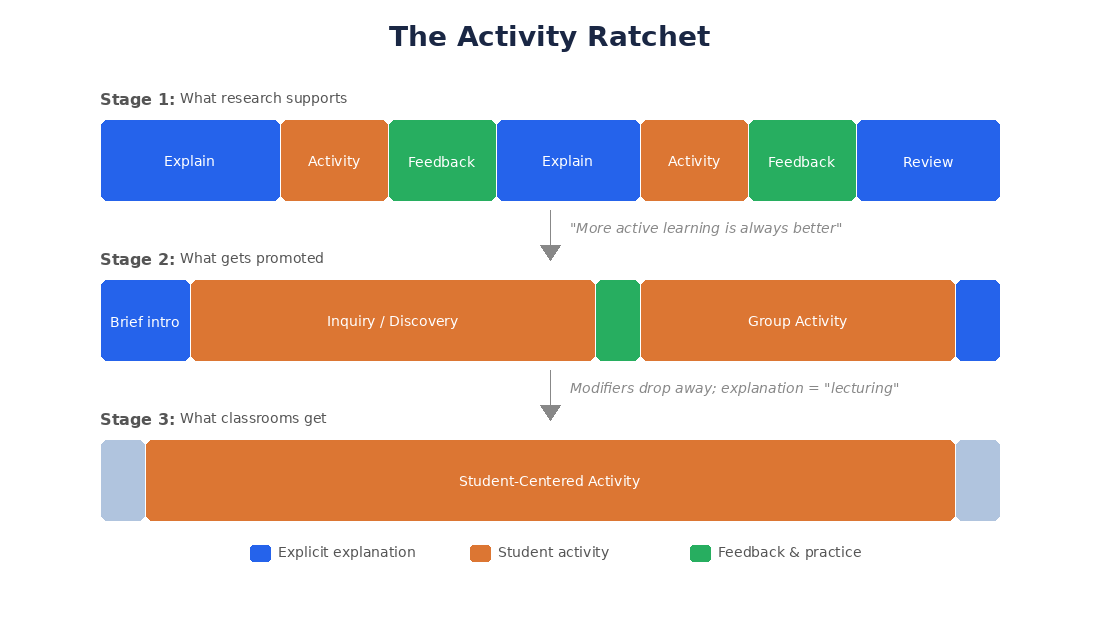
I call this the “activity ratchet.” Research findings that support modest engagement get progressively reinterpreted as mandates to minimize explanation altogether. Researchers preach nuance—“guided inquiry,” “scaffolded discovery”—but practitioners hear only the prestige term: active, inquiry, student-centered. The modifiers drop away. Teachers who explain clearly, correct errors promptly, and ensure students actually learn often feel they’re doing something wrong.
The real-world cost
This isn’t abstract. New Zealand embraced child-centered, discovery-based math for over thirty years. During that period, it fell from near the top of international math rankings to 19th. Teachers were trained to believe that correcting wrong answers would diminish student “status” and that getting the right answer “isn’t important.”
Finland’s story is eerily similar. Its spectacular 2000 PISA results were attributed to its new student-centered curriculum—but classroom practice at the time was still largely traditional and teacher-led. As practice actually shifted toward constructivism, and teachers trained under the new philosophy entered classrooms, scores dropped sharply. Finland’s own Ministry of Education acknowledged the decline was equivalent to roughly one to two years of lost learning.
Taiwan imported a U.S.-style constructivist math program in 1996. Achievement fell almost immediately. When the program was terminated in 2003, defenders blamed the culture rather than the pedagogy.
The students who suffer most are those for whom school is the only source of explicit teaching they’ll ever get. Affluent families can buy tutors and support extra practice. Poor families cannot. The activity ratchet turns fastest for those with the fewest resources to escape it.
Why it’s so hard to fix
A framework this entrenched doesn’t survive on logic alone. It survives because it’s been poured into concrete—literally. Open-plan “innovative learning environments” are built at enormous expense, and once built, they make sustained explanation harder to deliver and engagement harder to monitor. Discovery-oriented teaching seems more effective in these spaces because teachers find it difficult to explain through the din.
It survives because schools of education have taught constructivism as the default for decades. For faculty who’ve spent careers on these ideas, changing course means conceding that what they’ve long taught may have failed students.
And increasingly, it survives because AI echoes it back. Large language models are trained on educational writing, most of which treats inquiry-based teaching as the gold standard. Ask an AI for teaching advice, and it defaults to active learning and student-centered practices. Over time, what the AI suggests comes to feel like what everyone does—what you’re simply expected to do.
Cognitive realism
So what’s the alternative? Not a grand competing ideology. Something simpler.
I’ve started calling it cognitive realism: the view that there are facts about how brains encode, consolidate, and retrieve information, that these facts constrain what instructional approaches can succeed, and that our theories about those facts must remain open to revision when evidence says so.
A cognitive realist can acknowledge that inquiry has value under specifiable conditions. That explicit instruction builds the knowledge that makes later insight possible. That different approaches suit different subject matter and different levels of prior knowledge. What cognitive realism cannot accommodate is the claim that any instructional philosophy is exempt from evidence.
The key commitment is falsifiability. If you’re promoting a teaching method, you should be able to say in advance what outcomes would count as evidence against it. If no conceivable result could make you change your mind, you’re not doing science. You’re doing something else.
Working out the details is a research program, not a conclusion. But the first step is recognizing that education’s dominant framework has been running without a check engine light for decades—and that the students paying the price can’t wait for the next cycle of rediscovery.
I’m Barbara Oakley, a Distinguished Professor of Engineering at Oakland University and co-creator with Terry Sejnowski of “Learning How to Learn,” the world’s most popular online course. My new paper on the non-falsifiability of constructivism is forthcoming. If these ideas resonate, subscribe—more to come.
Sounds very much like the emphasis on "productive struggle" in U.S. math education. In my experience, you have to be very careful when, where, and how you use it. And w hen students don't have an adequate grasp over the foundations first, it often does more harm than good.
I’m curious about a few things, maybe you can point me on where I can read more on this
Is Montessori education a type of SCA education?? If it is, do those students do worse? Or is there some important criteria that makes them do better and SCA do poorly in other educational space?